
Checklist for TU defence
Having worked on teaching units for roughly two months now (since 17th November), and having already provided a considerable amount of feedback on my part, now is time to start rehearsing your oral defence.
To begin with, remember that you have a maximum of 30 minutes in which to explain everything included in your written document, namely, objectives, competences and contents, materials and resources, attention to diversity, assessment, etc.). The real emphasis, though, must be on the methodology and, above all, the step-by-step planning of your unit. Needless to say, you will not have time to explain every single activity in detail, so you must make a wise selection and focus on those that are particularly original/innovative/updated, be it because of a particular competence (e.g. interculturality), language activity (e.g. mediation), type of material or resource, web app, or a particular active methodology.
To help you in your first attempts at rehearsing the defence, below you have a self-assessment checklist that might steadily guide your work. Check it very carefully to know what is expected of you in that part, and be ready to self-assess yourselves.
Please, note that the oral defence is where the board will see both your attitudes and aptitudes to become a teacher. Everything matters here: what you say, how you say it, how you move and stand, how confident you look and sound, whether you are truly familiar with the context of EOIs, etc. Posts are very often decided on the basis of how well you manage to defend your unit.
Sample videos
I am a firm advocate of the modelling skill, probably the most essential one in NLP (Neuro-Linguistic Programming): observing and learning how others achieved something makes it easier to try and test different approaches to see what works for us. In short, modelling is about achieving an outcome by studying how someone else goes about it.
With that purpose in mind, several videos of candidates that obtained a post in the last call will be played in class. In regard to this, and following upon some candidates’ feedback concerning the poor sound quality of the last video, I have decided to post both that one and also the first one played on 12th November on the website as well.
IMPORTANT
The candidates that appear on the videos are fully aware of, and have given their explicit consent to this.
- Teaching Unit: sample 1 (12th Nov)
- Teaching Unit: Sample 2 (7th January)
Below you have a picture of what the board looked like at the end of the defence (Sample 2).
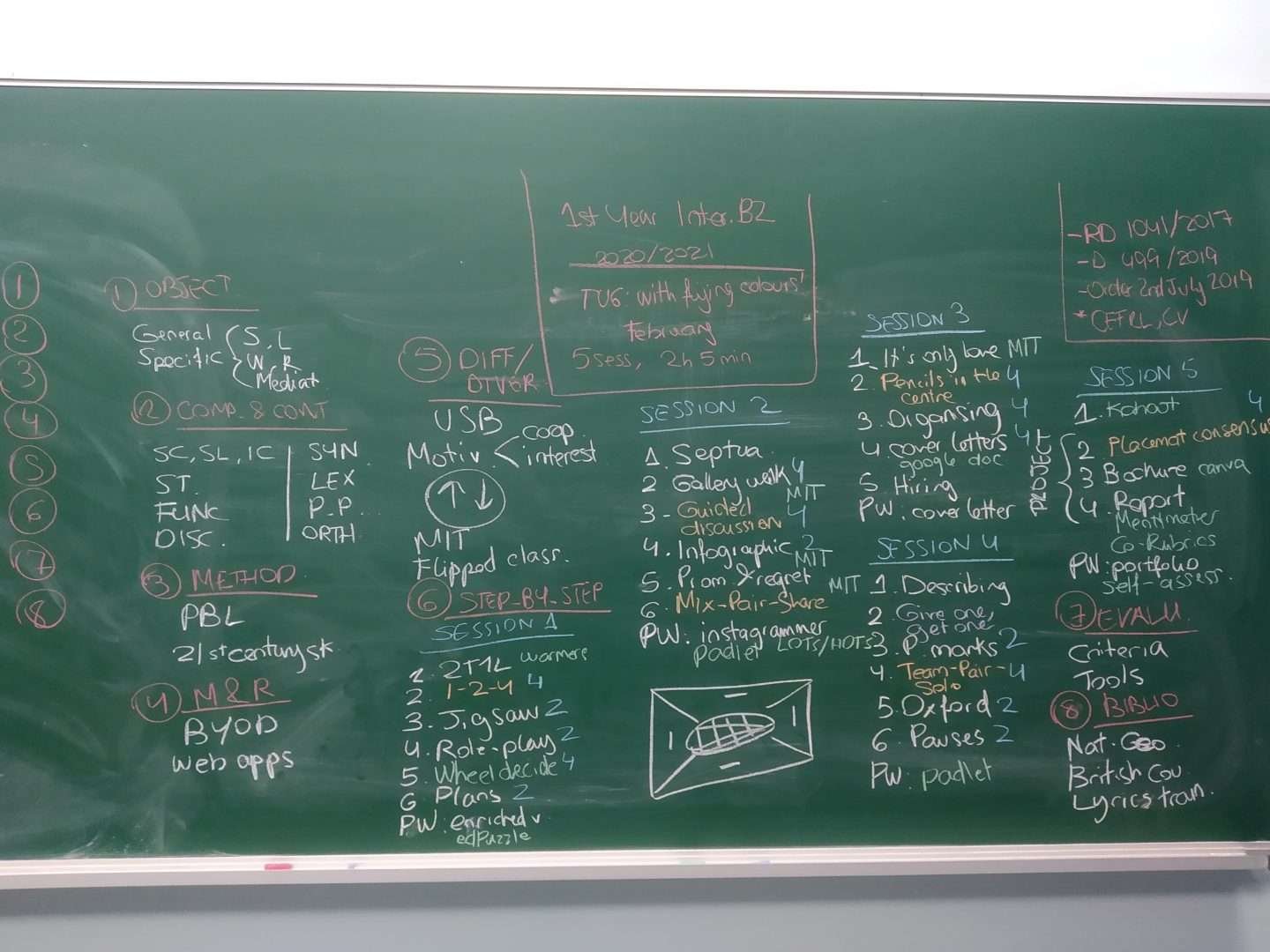
Every time you watch an oral defence, do it critically, highlighting the positive aspects, and delineating the areas for possible improvement. Indeed, samples always prove to be remarkable departing points for everything we set out to do: they can be certainly inspiring, and at the same time can also provide us with invaluable hints on what to avoid.